The History of Santa Rosa, California
From Ancient Native Lands to Wine Country’s Vibrant Heart
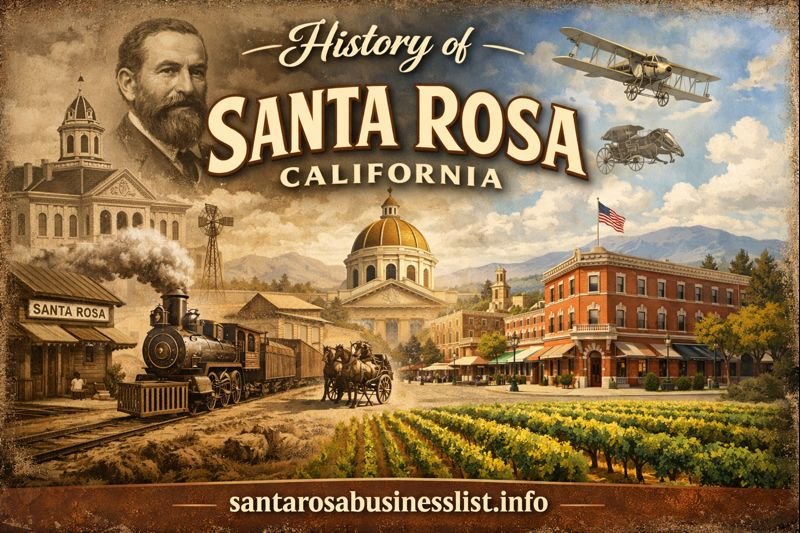
Santa Rosa, the largest city in California’s famed Sonoma County Wine Country, carries a history as rich and layered as the soil that has made this region world-renowned. From the footsteps of the Pomo people who called this land home for thousands of years, through devastating earthquakes and catastrophic fires, to the present day as the cultural and economic hub of Northern California’s wine country, Santa Rosa’s story is one of resilience, reinvention, and enduring community spirit.
The First Peoples: Pomo, Miwok, and Wappo Nations
Long before European explorers set foot in Northern California, the Santa Rosa Plain was home to thriving indigenous communities. The Pomo people, specifically a populous tribe known as the Bitakomtara, established villages throughout the region and lived in harmony with the abundant natural resources of the area for over 4,000 years.
The Miwok and Wappo tribes also inhabited the surrounding territories, creating a diverse tapestry of indigenous cultures. These native peoples developed sophisticated trading networks, with the Santa Rosa area serving as a crossroads of ancient trading routes. They harvested acorns from the oak woodlands, fished the streams, and hunted the wildlife that flourished in the temperate valley climate.
The arrival of Spanish missionaries and colonists in the early 1800s brought devastating consequences for these indigenous populations. Disease, displacement, and violence decimated their numbers. By 1900, the Pomo population had decreased by an estimated 95 percent from pre-contact levels. Today, descendants of these original inhabitants still live in the region, working to preserve their cultural heritage and traditions.
Spanish and Mexican Eras: The Carrillo Family Legacy
1833Santa Rosa was founded by Mexican colonists and named after Saint Rose of Lima, the first Catholic saint of the Americas. According to popular legend, Father Juan Amorosa bestowed this name after baptizing a young Native American woman in a local stream, following the Spanish tradition of naming waterways and settlements for saints.
The first permanent European settlement came with the arrival of the Carrillo family, who were in-laws to General Mariano Guadalupe Vallejo, the powerful Mexican military commander who controlled much of Northern California. In 1837, Doña María Ignacia Lopez de Carrillo, Vallejo’s mother-in-law and aunt of Mexican Governor Pio Pico, received a land grant of nearly 9,000 acres known as Rancho Cabeza de Santa Rosa.
The Carrillo family constructed an adobe home at the junction of ancient Native American trading routes near present-day Farmers Lane and Highway 12. This adobe became the first permanent European structure in what would become Santa Rosa. The ruins of this historic building still stand today behind St. Eugene’s Cathedral, a tangible connection to the city’s Mexican heritage.
“I have seen Doña María Ygnacia robed in a neat calico dress of a French texture, with a broad-brim straw hat made by one of her Indian women, mounted on a horse which had been broken to saddle by some of her sons expressly for her use.”
— William Heath Davis, early California traveler
The Carrillo rancho operated with the labor of local indigenous people, many of whom were former Mission Indians accustomed to agricultural work. The family raised vast herds of cattle and horses that grazed freely across the unfenced Santa Rosa plain. Doña María was known for her strong management of the rancho and reportedly could speak the local native language, facilitating relationships with her workers.
American Era and City Founding
1850sFollowing the United States’ victory in the Mexican-American War and California’s admission to the Union in 1850, American settlers began arriving in the Santa Rosa area. A Wells Fargo post and general store were established in what is now downtown, marking the beginning of American commercial development.
Julio Carrillo, son of Doña María, played a pivotal role in the transition to American rule. Working with three enterprising businessmen—Berthold “Barney” Hoen, Feodor Gustav Hahman, and William Hartman—Julio helped lay out the grid street pattern that still defines downtown Santa Rosa today. The partners plotted out a town and offered all lots for just $25 apiece.
Barney Hoen launched a campaign in 1854 to make Santa Rosa the county seat, promising that he and others would donate land for a courthouse. Julio Carrillo offered to donate land for a town square. Their efforts succeeded, and county residents voted to transfer the seat of government from Sonoma to Santa Rosa, establishing the city’s role as the political and economic center of Sonoma County.
1867-1868Santa Rosa was officially recognized as an incorporated city by the county in 1867 and confirmed by the state in 1868, making it the third incorporated city in Sonoma County after Petaluma and Healdsburg.
Luther Burbank: The Plant Wizard of Santa Rosa
No figure is more synonymous with Santa Rosa’s identity than Luther Burbank, the legendary horticulturist who transformed the city into a global center of agricultural innovation. Born in Lancaster, Massachusetts on March 7, 1849, Burbank would spend over 50 years in Santa Rosa, developing more than 800 new varieties of plants that changed agriculture worldwide.
🌱 Luther Burbank by the Numbers
• 800+ new plant varieties developed over 55 years
• 113 varieties of plums and prunes
• 50+ varieties of lilies
• 3,000 experiments conducted simultaneously at his peak
• $150 — the amount he sold his famous Burbank potato for to fund his move to California
Burbank’s journey to Santa Rosa began with a potato. In 1871, at just 21 years old, he discovered a rare potato seed ball and planted its 23 seeds. One produced exceptional potatoes—large, firm, and disease-resistant. He sold the rights to what became known as the Burbank potato (later the Russet Burbank, now the world’s most widely cultivated potato variety) for $150 and used the money to travel to California in 1875.
“I firmly believe, from what I have seen, that this is the chosen spot of all this earth as far as Nature is concerned.”
— Luther Burbank, on choosing Santa Rosa
In Santa Rosa, Burbank established nursery gardens and greenhouses that became famous throughout the world. In 1885, he purchased 18 acres nearby in Sebastopol for his experimental farm, where he conducted thousands of simultaneous experiments. His methods involved creating multiple crosses of foreign and native plant strains, then grafting promising seedlings onto fully developed plants to rapidly assess their characteristics.
Burbank’s Most Famous Creations
Among Burbank’s most celebrated achievements was the Shasta Daisy, a quadruple hybrid that remains one of the most popular flowers in gardens today. He also developed the Santa Rosa Plum, a complex hybrid that is still among the most cultivated varieties in the United States more than a century after its introduction in 1906.
Burbank created the plumcot, an entirely new fruit resulting from crossing plums with apricots. He developed the white blackberry, bred specifically so that it wouldn’t stain hands and clothing. His spineless cactus provided improved forage for livestock in arid regions. The Freestone Peach and Paradox Walnut (still the most common rootstock for walnuts today) further demonstrated his versatility.
Burbank’s fame attracted visits from the most prominent figures of his era. Henry Ford, Thomas Edison, and Harvey Firestone all traveled to Santa Rosa to meet the “Plant Wizard” and pose for photographs with him. His 1893 catalog “New Creations in Fruits and Flowers” caused an international sensation, with some religious critics objecting that Burbank claimed powers of creation reserved only for God.
Luther Burbank died on April 11, 1926, at age 77, and is buried near the greenhouse at his Santa Rosa home. His legacy lives on through the Luther Burbank Home and Gardens, now a National Historic Landmark, and the Luther Burbank Center for the Arts. California celebrates his birthday, March 7, as Arbor Day in his honor. In 1986, he was posthumously inducted into the National Inventors Hall of Fame, and the Plant Patent Act of 1930, passed four years after his death, was inspired by his work. As Thomas Edison testified in congressional hearings: “This bill will, I feel sure, give us many Burbanks.”
The Catastrophic 1906 Earthquake
April 18, 1906At 5:12 in the morning, the great San Andreas Fault ruptured along nearly 300 miles of the California coast. While the disaster is remembered as the “1906 San Francisco Earthquake,” Santa Rosa suffered devastation that was, proportionally, even more severe than the famous city to the south.
According to a 2005 U.S. Geological Survey study, the shaking was actually more intense in the area between Santa Rosa and Sebastopol than in San Francisco itself. The earthquake registered XI (Extreme) on the Modified Mercalli intensity scale in Santa Rosa, where the destruction was catastrophic.
“I arose and undertook to dress myself, but was thrown back on the bed and found it impossible to stand even by holding onto objects usually stable, receiving such a shaking as I never before experienced. During the earthquake there was such a general noise of falling buildings that little else could be heard, even loud shouting was almost lost in this general babel of noises.”
— Luther Burbank, eyewitness account, 1911
The earthquake struck while most residents were still asleep. Within seconds, virtually every brick and stone building in downtown Santa Rosa collapsed. The courthouse, Hall of Records, the Occidental and Santa Rosa Hotels, the Athenaeum Theatre, the new Masonic Temple, Odd Fellows’ Block, and all the banks were destroyed. Of the entire downtown, not one brick or stone building was left standing except the California Northwestern Railroad Depot.
Luther Burbank rushed to the devastated business district, which he described as a “hopeless mass of ruins” where there were piles of bricks and rubble, gas leaks, and fires. Eyewitness Green Thompson reported that “all of the buildings fell at once; no one first” and that the dust on Fourth Street was so thick he couldn’t see. The gas remained on after the buildings collapsed, feeding fires that created an inferno in portions of downtown.
The death toll in Santa Rosa remains debated by historians, with estimates ranging from 61 to over 100 people killed. What is certain is that the city sustained more damage, in proportion to its size, than any other affected community. One remarkable exception was St. Rose Catholic Church, an extraordinarily well-built stone structure completed just five years earlier in 1901. With the exception of a few stones from a cornice and minor steeple damage, the church came through essentially unscathed—a testament to superior construction.
Despite the devastating destruction of its commercial buildings, almost all of Santa Rosa’s wooden residential homes survived. These historic houses still stand throughout the city’s older neighborhoods, many of them beautiful Victorian-era structures. The earthquake also spared Railroad Square, where several rough-hewn stone buildings, including two that predate the earthquake, still stand today as one of the city’s most popular historic districts.
Rebuilding and Growth Through the 20th Century
Santa Rosa rebuilt after 1906, but population growth remained slow for decades. The city gradually evolved from a small farming town into a regional center. The railroad, which had first arrived in 1870, continued to drive commercial development. By 1900, the population had reached 6,673, and the city was becoming known as a hub for agricultural commerce.
1969On October 1, 1969, two earthquakes of magnitude 5.6 and 5.7 struck Santa Rosa in quick succession—the largest quakes to affect the city since 1906. Though far less powerful than the earlier disaster, these earthquakes caused about $8.35 million in damage and killed one person. The earthquakes prompted the city to pioneer seismic retrofitting standards that would become a model for California.
The post-World War II era brought significant growth. Santa Rosa had served as the location for Naval Auxiliary Landing Field Santa Rosa during the war, and returning veterans helped fuel expansion. The population increased by two-thirds between 1950 and 1970, averaging 1,000 new residents annually. By 2000, the population had reached 147,532, making Santa Rosa the largest city in Sonoma County and the fifth most populous in the Bay Area.
Charles M. Schulz and the Peanuts Legacy
In 1958, another beloved figure arrived who would forever link his name with Santa Rosa. Charles M. Schulz, creator of the Peanuts comic strip, moved his family to Sonoma County and established his studio here. For over 40 years, until his death on February 12, 2000, Schulz drew every single Peanuts strip from Santa Rosa.
Schulz embraced his adopted hometown, building the Redwood Empire Ice Arena (now known as Snoopy’s Home Ice) in 1969. An avid hockey player, he founded Snoopy’s Senior World Hockey Tournament in 1975 and was awarded the Lester Patrick Trophy for outstanding service to American hockey in 1981. He was also a longtime member of the Santa Rosa Golf and Country Club.
The city has embraced Schulz’s legacy wholeheartedly. The Charles M. Schulz–Sonoma County Airport bears his name, featuring Peanuts sculptures throughout. The Charles M. Schulz Museum and Research Center opened in August 2002, two years after his death, housing the world’s largest collection of original Peanuts strips. Bronze statues of Charlie Brown, Snoopy, Lucy, Woodstock, and other beloved characters can be found throughout Santa Rosa, part of the “Peanuts on Parade” public art initiative that began in 2005.
The 2017 Tubbs Fire: Trial by Fire
October 8-9, 2017The Tubbs Fire would become one of the most destructive wildfires in California history, testing Santa Rosa’s resilience in ways not seen since 1906. The fire started near Tubbs Lane in rural Calistoga on the evening of October 8, driven by Diablo winds that reached nearly hurricane strength—over 60 miles per hour.
By 1:00 a.m. on October 9, the fire had reached Santa Rosa’s city limits, advancing from the north into the Fountaingrove area. Moving down ravines at terrifying speed, the flames soon crossed Highway 101. By 4:30 a.m., the fire had devastated the Coffey Park neighborhood, leveling an estimated 1,300 homes in a matter of hours.
The destruction was staggering. The historic Fountaingrove Round Barn, one of Santa Rosa’s most iconic landmarks, was completely destroyed. The Fountaingrove Inn, a large Hilton hotel, and 116 of 160 units at the Journey’s End Mobile Home Park were lost. Entire cul-de-sacs in Fountaingrove were obliterated. When the fire was finally contained on October 31, it had burned 36,810 acres and destroyed more than 5,643 structures, making it (at the time) the most destructive wildfire in California history.
Twenty-two people lost their lives in Sonoma County from the Tubbs Fire. Tens of thousands were evacuated with little notice, many fleeing in whatever they were wearing, unable to gather family mementos, documents, or even pets. First responders—firefighters, police officers, and even city bus drivers—worked through the night to evacuate residents, some losing their own homes while saving others.
Yet Santa Rosa’s spirit of resilience emerged once again. By 2022, five years after the disaster, more than 90 percent of homes burned had been rebuilt, were under construction, or had been approved for rebuilding. The community came together in ways both large and small, demonstrating the same determination that rebuilt the city after 1906.
Santa Rosa Today
Modern Santa Rosa serves as the financial, medical, and shopping hub for all of Northern California between San Francisco and Portland, Oregon. With a population of approximately 178,000, it remains Sonoma County’s largest city and a gateway to world-renowned wine country.
The city’s historic Railroad Square, with its early 1900s architecture and the still-functioning Hotel La Rose (built in 1907), is listed on the National Register of Historic Places and featured in Alfred Hitchcock’s 1943 film “Shadow of a Doubt.” The Luther Burbank Home and Gardens welcomes visitors year-round, while the annual Luther Burbank Rose Parade and Festival celebrates the horticultural legacy that put Santa Rosa on the global map.
From the ancient villages of the Pomo people to the grand ambitions of Mexican rancheros, from Luther Burbank’s revolutionary gardens to Charles Schulz’s beloved comic strips, Santa Rosa’s history reflects the broader California story—one of diverse peoples, natural challenges, and remarkable resilience. Through earthquakes and fires, boom times and hardship, Santa Rosa has continually reinvented itself while honoring the memory of all who came before.
Today’s visitors and residents alike can walk streets laid out by Julio Carrillo, admire Victorian homes that survived the 1906 earthquake, pay respects at Luther Burbank’s gravesite, pose with Snoopy statues, and explore rebuilt neighborhoods that rose from the ashes of 2017. In Santa Rosa, history isn’t just remembered—it’s lived.